Home Care Nurse vs. In-Home Caregiver: What's the Difference (and Which Does Your Loved One Need)?
If you're caring for an aging parent or loved one, chances are you've heard a lot of terms thrown around lately.
Home care nurse.
In-home caregiver.
Home health.
Personal care.
....And somewhere in the middle of all that, you're just trying to figure out what kind of help your loved one actually needs.
You're not alone. This question comes up all the time, especially when a loved one wants to stay at home but clearly needs more support than they used to. The confusion usually isn't about whether help is needed. It's about what kind of help makes the most sense.
Today we're here to slow things down and walk through the difference between a home care nurse and an in-home personal caregiver in plain language so you can make a confident decision for your family.

Table of Contents
- Why more seniors are choosing to age at home
- What a home care nurse actually does
- What an in-home personal caregiver does day to day
- Home care nurse vs. caregiver: side-by-side comparison
- How to know which type of care your loved one needs
- When families need both nursing and caregiver support
- What families often overlook when choosing care
- How 4 Seasons Home Care supports families
- Frequently Asked Questions
Why more seniors are choosing to age at home
Most seniors don't dream of spending their later years in a facility. They want their own bed. Their own kitchen. Their routines, their neighbors, their sense of normal. Aging at home feels familiar and grounding, especially during seasons of change.
But aging at home often comes with new challenges: Health conditions show up. Mobility changes. Daily tasks take longer or feel harder. And eventually, families reach a point where love alone isn't enough. Extra support becomes necessary.
This is where the question usually starts: do we need medical care at home, or do we need help with everyday life? At 4 Seasons Home Care, we help families navigate this question everyday, and we're here to help. Keep reading.
What a home care nurse actually does
A home care nurse is a licensed medical professional, typically a registered nurse or licensed practical nurse. Their role is focused on medical needs that require clinical training and oversight.
Home care nurses usually come into the home for very specific reasons. They're there to treat a condition, manage a medical situation, or follow a doctor's orders. Their visits tend to be structured, time-limited, and task-focused.
Examples of what a home care nurse may help with include
- managing wound care
- monitoring complex medical conditions
- administering injections or infusions
- managing catheters or ostomies
- supporting post-surgical recovery
- or providing respiratory treatments.
In most cases, nursing care at home is prescribed by a physician and covered by insurance. The schedule is often short-term or intermittent. A nurse might visit once a week, once a month, or for a limited period after a hospitalization.
What's important to understand is this: a home care nurse is not there to stay all day, keep someone company, cook meals, or help with daily routines. Their focus is medical, not lifestyle.
What an in-home personal caregiver does day to day
An in-home caregiver supports the non-medical side of life. This is the person who helps your loved one get through the day safely, comfortably, and with dignity.
Caregivers help with things like:
- bathing
- dressing
- grooming
- toileting
- mobility
- meal preperation
- house chores
- runing errands
- providing transportation
- offering companionship
- They also provide medication reminders, (not administration) and keep an eye on changes in routine or behavior.
For many families, this type of support is what actually makes aging at home possible. It's the steady presence. The extra set of hands. The reassurance that someone is there when you can't be.
Unlike nursing care, caregiver support can be scheduled around your loved one's life. A few hours a week. Overnight care. Daily visits. Long-term support. It's flexible and designed to evolve as needs change!
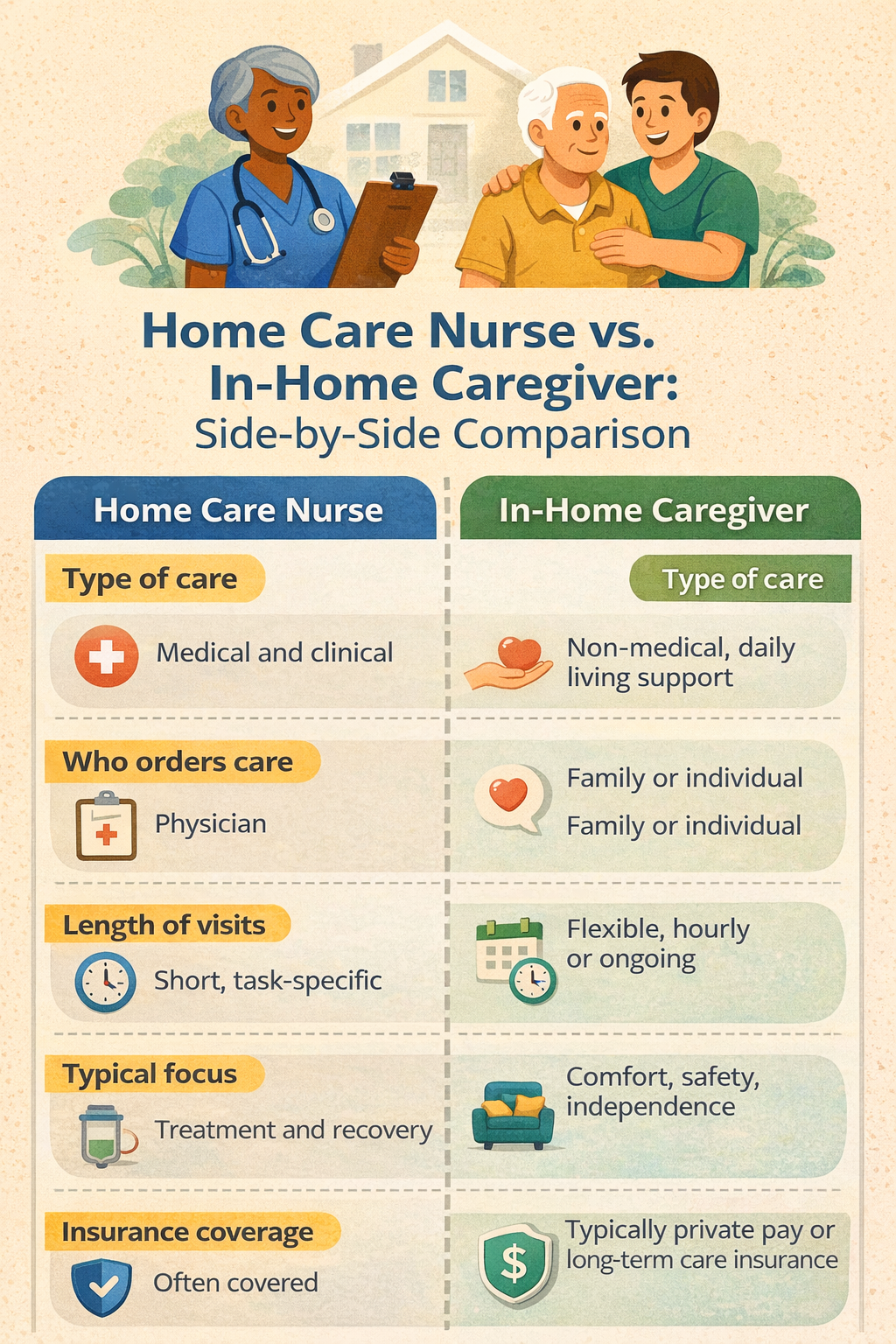
Home care nurse vs. caregiver: side-by-side comparison
| Category | Home Care Nurse | In-Home Caregiver |
|---|---|---|
| Type of care | Medical and clinical | Non-medical, daily living support |
| Who orders care | Physician | Family or individual |
| Length of visits | Short, task-specific | Flexible, hourly or ongoing |
| Typical focus | Treatment and recovery | Comfort, safety, independence |
| Insurance coverage | Often covered | Typically private pay or long-term care insurance |
How to know which type of care your loved one needs
This decision usually becomes clearer when you step back and look at what's actually creating stress or risk in daily life.
If your loved one's biggest challenges are medical, like wound care, injections, or complex treatments, then nursing care may be necessary, at least temporarily.
If the challenges are more about daily life, getting dressed, cooking safely, remembering medications, moving around the house, or feeling lonely, then an in-home caregiver is often the better fit.
Many families assume medical care must come first, but that's not always true. In reality, most seniors need help with everyday living long before they need clinical nursing support.
When families need both nursing and caregiver support
Sometimes the right answer isn't either or. It's both.
A common scenario looks like this: a home care nurse visits occasionally to manage a medical condition, while a caregiver provides consistent daily support. The nurse handles the clinical side; the caregiver handles the rest of life.
This combination often works beautifully, especially for seniors with chronic conditions who still want to live fully at home.
What families often overlook when choosing care
One of the biggest things families underestimate is how exhausting caregiving can become. Even when everyone has the best intentions, juggling work, kids, and caregiving adds up fast.
In-home caregivers don't just support seniors. They support families and they create breathing room. They reduce burnout. They allow adult children to step back into the role of son or daughter instead of full-time caregiver.
How 4 Seasons Home Care supports families
At 4 Seasons Home Care, we specialize in non-medical, relationship-based caregiving. Our caregivers support seniors with daily routines, safety, companionship, and the little details that make life feel normal again.
We work alongside families, doctors, and other providers when needed. And we adjust care as life changes, because it always does.
If you're feeling unsure about what kind of help your loved one needs, we're happy to talk it through. Sometimes the most helpful thing is simply having a conversation.
Frequently Asked Questions
Does my loved one need a nurse or a caregiver?
If the need is medical, start with a doctor. If the need is daily living support, a caregiver is often the right place to begin.
Can a caregiver replace a nurse?
No. Caregivers don't provide medical treatments, but they do support everyday safety and comfort.
How many hours of care should we start with?
Many families start small and adjust over time. Even a few hours a week can make a big difference.
Is in-home caregiving long-term?
It can be short-term or ongoing, depending on your loved one's needs.
Can 4 Seasons help us figure this out?
Absolutely. We help families understand their options and build a care plan that fits real life. Reach out to us today.